
A Knife in the Back in Venice: 25 Minutes of Applause at the Expense of IDF Soldiers
Yuval Abraham and Rachel Szor took 24 anonymous witnesses to a European festival and came home with a prize. The soldiers and the country will pay the price.
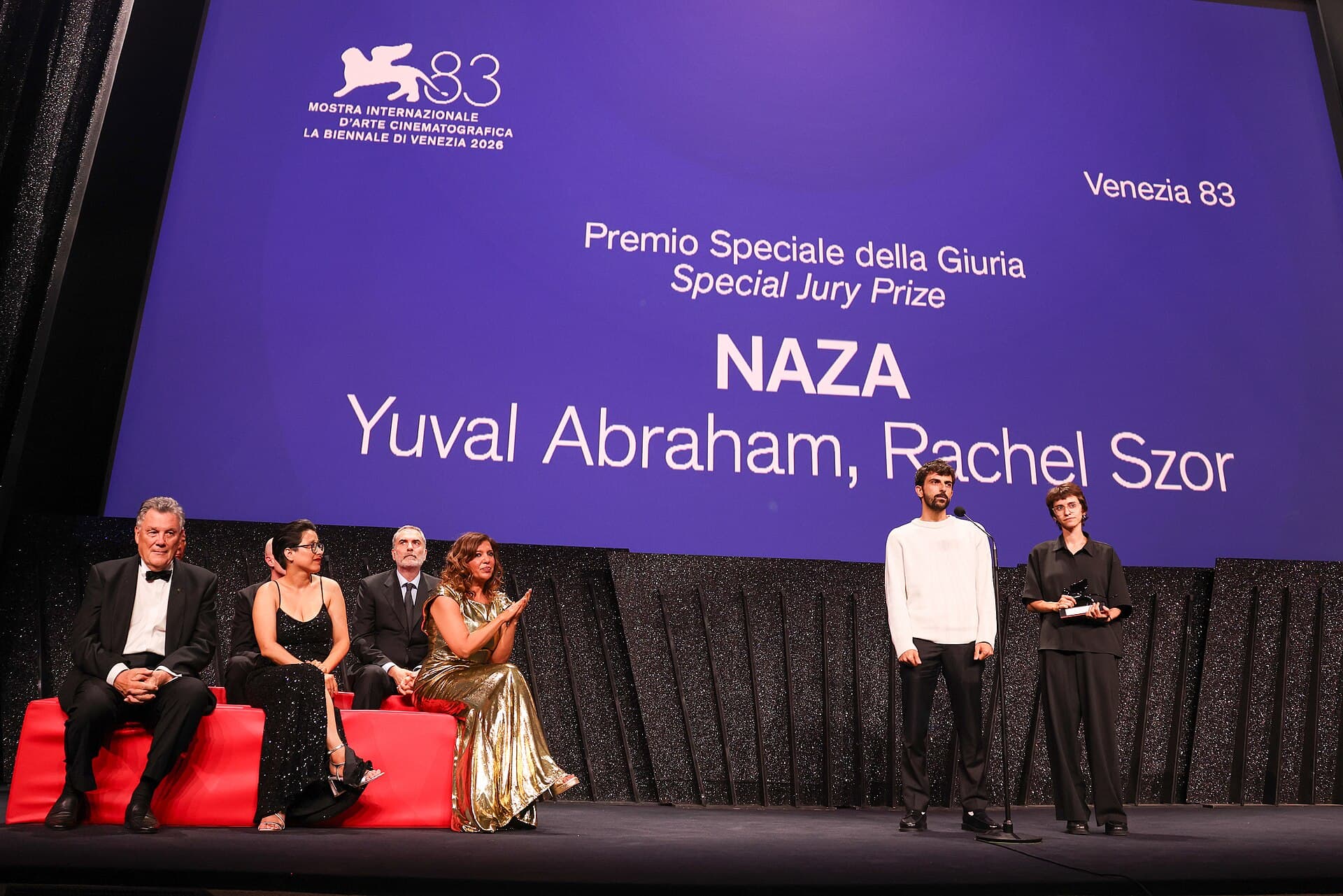
Wikimedia Commons, Ondine Goat, CC BY-SA 4.0
Twenty-five minutes of applause in a Venice hall. For what? For an Israeli film accusing IDF soldiers of knowingly killing civilians. Not a foreign rival, not a terror group. Israelis, who filmed on Tel Aviv rooftops under the wing of a British newspaper and took their own country to the dock before the whole world. At Torenu we see no reason to soften it: this is a betrayal. A betrayal of the soldiers we send to fight, of a nation fighting for its life, and of the trust that should exist between Israelis.
## What they did
NAZA is the Hebrew acronym for "incidental damage." The film, about 80 minutes long, is built on accounts from 24 anonymous soldiers and intelligence personnel who, according to its makers, describe the orders and approval systems behind the bombing of Gaza. The conclusion it hands the world: the IDF killed civilians knowingly.
The film was made by Yuval Abraham and Rachel Szor, two of the directors of *No Other Land*. It was produced by The Guardian together with James Wilson, with Jonathan Glazer as executive producer. It is a polished international machine with an obvious destination: festivals, prizes, headlines, and then diplomatic pressure on Israel.
This is not an argument about cinema. These are people who chose, with their talent, their connections and their funding, to turn their own country's fighters into defendants.
## 24 witnesses with no name
The first rule of journalism is that whoever accuses must prove. Abraham says The Guardian verified the witnesses' identities and the cases. In other words, the producer vouches for itself. We have not seen the verification, and no outsider has reviewed it. Raviv Drucker of Channel 13, whom nobody would suspect of being right-wing, said there is no public evidence supporting the claims. When someone from their own camp says it, those who applauded in Venice evidently checked nothing.
## The double standard
Note the rules of the game. When the target is the IDF, an anonymous witness becomes a hero, and the inability to test him is taken as proof that something is being hidden. Try imagining a parallel film, built on 24 anonymous witnesses accusing the judiciary or the media of corruption. Which festival would give it a prize? Which global newspaper would fund it? Obviously none. But here everyone is ready to waive the checking, because the finding suits them.
## Who pays the price
Not the directors. They will receive more festival invitations. The price will be paid by IDF soldiers, who will stand before an indictment they have no way to refute, and by a country fighting for its life, to whose enemies this film hands ready-made material for courtrooms, the UN and the squares. The Foreign Ministry has already sent diplomats guidance describing the film as "Hamas propaganda in disguise." The IDF "categorically rejects" the allegations, questions the credibility of the sources, and stresses that targeting decisions are made "by human personnel only."
And there is one more grave question. Chief of Staff Eyal Zamir instructed the Military Advocate General to examine whether the film relied on leaked classified material. If soldiers or intelligence personnel handed secret documents to a foreign newspaper, that is no longer free speech. It is an act that harms the security of the state, and whoever did it should answer for it.
## The decision to do it now
Anyone who releases such a film to European festivals while Israel is under an unprecedented diplomatic and legal assault knows what will be done with it. He knows, and it is his choice.
For anyone who believes there is a problem in the army's conduct there are channels: the Military Advocate General, the Foreign Affairs and Defense Committee, the State Comptroller, the courts. There material can be submitted, examined, and someone bears responsibility. We do not know whether the makers or the witnesses turned to them. What we do know is that they chose to bring the film to a hall in Venice. And anyone who chooses that route is hard to believe when he says he seeks correction. He seeks a stage.
## And the cultural elite?
The response was not late in coming: more than 1,600 Israeli film professionals signed a petition against an "unprecedented campaign of incitement." Not one of them asked where the evidence is. When it comes to the IDF, they do not need evidence, only a side. Culture Minister Miki Zohar asked to examine revoking citizenship and whether treason is involved, and the Prime Minister called the film "shocking." Whether this is treason in the legal sense belongs to the authorities and the courts. The moral verdict belongs to us, and it is already clear.
## What to demand
- **Full publication of the verification method.** Who checked the witnesses, how, and by what criteria. - **Separation of testimony from conclusion.** "I received an order" is testimony. "The order was meant to kill civilians" is the director's interpretation. - **Independent external review** of the central cases against operational records. - **A full and prompt inquiry into the classified-material question.** - **Transparency on funding.** How much Israeli public money, if any, went to a film accusing the IDF of murder.
Millions of people around the world will see this film, and they will know none of this. They will know that Israeli soldiers said something and that the hall applauded. The difference between a documentary and an indictment with a soundtrack is the ability to check it. As long as that is impossible, the honest headline is not "the film revealed" but "the film claims." And the question that remains open is how Israelis can stand on a stage in Europe and serve the IDF to the world on a platter, without serving it a shred of proof.
Join Torenu's newsletter
One sharp email a week. Clear analysis. No noise.
Related posts
Haaretz Turns a Denial Into a Confession: Netanyahu and the Egyptian Intelligence Chief's 59 Minutes
Netanyahu confirmed on Channel 14 that Egypt's intelligence chief landed in Israel before October 7, and denied meeting him. Haaretz headlined it 'Netanyahu admitted'. The gap between the statement and the headline is the story.
Ynet Gives Retired Justice Meltzer a Stage to Defend the 0-11 Ruling, Two Weeks Before the Vote
Hanan Meltzer told ynet's 'People of the State' conference he does not regret the 2020 ruling that let Netanyahu form a government. The venue, the panel and the word 'coup' were all chosen by the same media house.
Israel's Ambassador Meets Marine Le Pen: How the Diplomatic Establishment's Boycott Served Progressive Narratives
Israel's ambassador to France held a secret meeting with Marine Le Pen after years of treating her as persona non grata. The policy shift reveals how diplomatic orthodoxy constrained Israel's strategic options based on progressive sensibilities about acceptable political partners.